Sign in. It’s quick, free and it’s up to you.
An account is an optional way to support the work we do. Find out more.
Sign in. It’s quick, free and it’s up to you.
An account is an optional way to support the work we do. Find out more.
LAST UPDATE | 5 Nov 2024
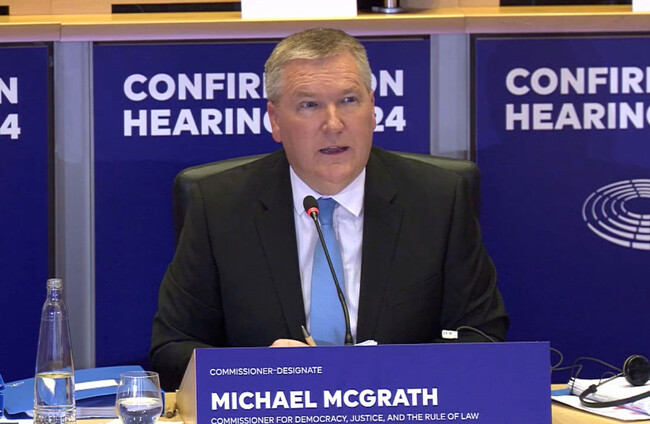
MICHAEL MCGRATH BELIEVES there may be “aspects of dynamic pricing that do constitute an unfair commercial practice” and that he would be interested in looking into the issue further in his new role as a European Commissioner
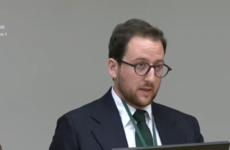
A prepped and eager McGrath this morning took questions in front of over 140 MEPs who wanted to see how tough he will be as the next potential European Commissioner for Democracy, Justice and the Rule of Law.
MEPs this afternoon voted to approve of the Cork native’s position, which will be confirmed at a European Parliament sitting later this month. As part of his new role he will be in charge of enforcing consumer protection regulations across the EU.
In his opening remarks, McGrath said he wants introduce a “digital fairness act” which would ban dark patterns and harmful algorithms – a move that advocates have highlighted as current shortfall in, otherwise tough, EU social media policy.
He added that a new consumer enforcement agency should also be established, so that an authority in every jurisdiction has the investigatory power to find out whether consumers’ rights were breached.
Asked about ways to tackle dynamic pricing, McGrath acknowledged there was a “big debate” in Ireland on the topic since the sale of Oasis tickets in August. In September, the local consumer protection agency launched an investigation into the matter.
Speaking in Brussels today, McGrath said: “Dynamic pricing is not prohibited in EU law, traders can freely determine their prices so long as they adequately inform consumers about the total price.
“But, there may be aspects of dynamic pricing that constitute an unfair commercial practice that the current examination [in Ireland] may well be taking place. I want to look at this in the context of the Digital Fairness Act,” he said, adding it was an issue “particularly in the event-ticket sector”.
Throughout the meeting, the former finance minister was quick to list off his priorities and named a number of key pieces of legislation that he believes will be important to implement to make sure he has an impact on improving democracy, the rule of law and access to justice in the EU.
In his opening address, he supported European Commission President Ursula von der Leyen’s plan for a ‘Democracy Shield’, aiming to better protect the right to vote, the fairness of elections, the freedom of expression and of the media in the EU.
No topic under the Fianna Fáil politician’s new brief went unmentioned during the three-hour Commissioner confirmation hearing in Brussels as parliamentarians asked for his thoughts on the rule of law to data protection reform to the protection of victims’ rights.
The rule of law dominated most of this morning’s hearing as there have been growing concerns about Hungary’s backsliding when it comes to the issue of democracy and the rule of law.
Based on conversations with MEPs in private session, McGrath said it was clear to him that “slippage” in the rule of law is an EU-wide issue and said he wanted to develop mechanisms to improve the situation.
On many occasions, far-right MEPs made it easy for McGrath as almost all of their questions centred around the same idea: removing the link between EU funding and alleged breaches in the rule of law.
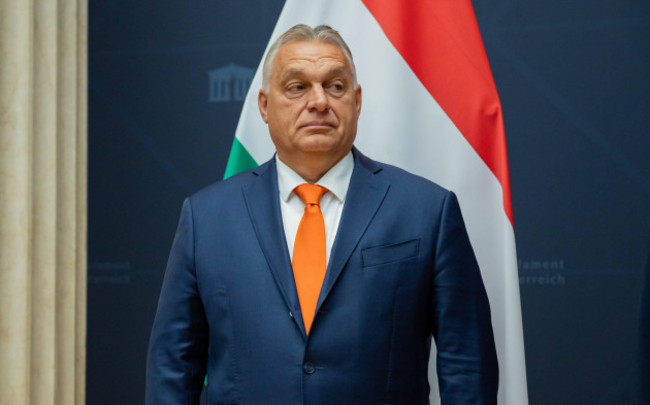
This question was primarily posed by MEPs from Hungary and Poland, whose member states have both faced a revocation and freeze of European monetary aid after the EU found proposed changes in its laws were in breach of civil and human rights.
Sanctions on Poland have since been lifted after a change of government repealed a controversial change to its judicial system but calls for the EU to intervene in Hungary have only grown more popular in recent years.
In July, Fine Gael MEPs and their European colleagues renewed calls to invoke Article 7 of the Treaty of the European Union on Hungary - which would block Prime Minister Viktor Orbán and other Hungarian representatives from voting in Brussels.
The request has been in front of EU leaders for years, as Hungary continue to act out in defiance of its EU allies over its anger to its funding freeze.
Over and over again, McGrath was quick to stand up European sanctions for alleged breaches of human rights in response to questions from politicians demanding that Governments not face any consequences for breaches.
McGrath says the charter of human rights and the treaties that make up the EU and that he and other commissioners will be the 'guardians' of EU law. He says that while a number of checks and balances must be included in that law, it must always uphold the rights' of citizens.
— Muiris Ó Cearbhaill (@muirisoc) November 5, 2024
The European Commission recently launched a legal challenge against Hungary over it’s Russian-like ‘foreign influence’ law, which would ban domestic media companies and NGOs receiving international investment.
Though the EU said it wants to deal with the court proceedings ‘swiftly’, McGrath may need to step in to lead the case as part of his new brief if the hearings continue. He today said be believed the court proceedings were a useful tool for the EU.
But just one politician, Dutch Green MEP Tineke Strik, actually challenged McGrath on the rule of law in the EU and questioned if the EU is taking the issue of backsliding seriously enough.

She said that countries like Hungary have been the subject of multiple concerns and yet, nothing is done about it at the executive level of the EU. Strik asked if intends to introduce stronger powers and if he supported Article 7 being introduced.
McGrath agreed that more needed to be done and vowed to establish how the European institutions would best use the frameworks and tools established by his predecessors.
He called on the European leaders to made a decision in regards to the Article 7 request and promised to keep the pressure on member states by continuing to annually publish a report on the rule of law across the EU.
McGrath was able to answer questions quickly and with ease throughout the order. MEPs from both sides of the political spectrum told him during the hearing that they were impressed by him already.
While he has been seen as a safe pair of hands in Brussels, the parliamentarians wanted to see how much of a tough, hardened regulator he would be to keep member states, like Hungary, in line during his five-year term.
Veteran German MEP and co-leader of the Green group Terry Reintke signalled this yesterday, telling journalists that the Co Cork-native will need be “un-Irish” during his term.
“I don’t know if this is a stereotype that is shared across Europe, but Irish people are considered to be very polite and friendly quite often, and I think he will have to be rather tough,” Reintke said.
German centre-right MEP Moritz Körner put this plainly to McGrath today: “Will you be a pain in the ass of wannabe autocrats in the [EU]?”
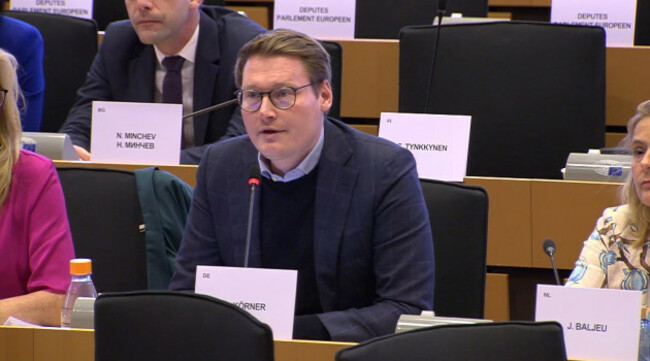
McGrath said:
“In relation to the rule of law, more generally. My approach will be, yes, dialogue – I will be diplomatic – but nobody should mistake that for weakness because there will be a cast-iron commitment to acting with all the tools we have now.”
McGrath received applause on three occasions by most MEPs in the room when questioned about immigration or asked if he would create laws that will overturn the decisions of judges that are ‘against the sovereign will of the people’ by the far-right.
The Cork native was put under pressure on the issue of victims’ rights as MEPs reopened old wounds. McGrath had earlier said it was his objective to establish a victims’ rights strategy and to extend justice to as many people as possible.
Belgian MEP Assita Kanko asked about a previous disagreement in the EU, however, when questioning if McGrath would be seeking a EU-wide definition of rape.
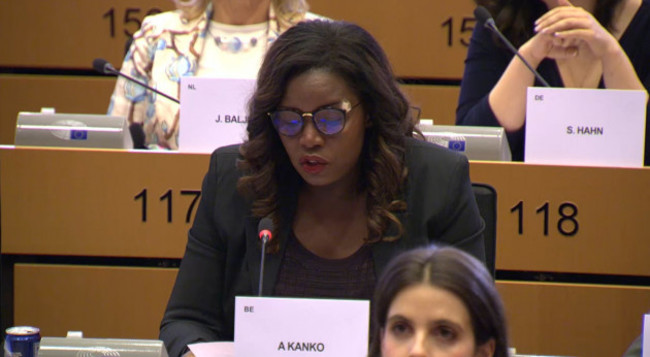
A law against violence against women, the first of its kind, was approved last year by the EU but the political bloc could not come to an agreement over the definition of sexual assault. It was seen as a major shortfall of the legislation.
McGrath said that he will be seeking that the Commission direct member states to have consent-based approached to their definitions, as much as possible, and told Kanko that he would like to continue to work with her on the issue.
Speaking after the hearing, the chairs of the justice, internal market and legal affairs committees all commended McGrath and MEPs for having a “remarkable approach to the hearings” and admitted that the atmosphere was “very, very, very positive”.
The coordinators, who will later decide how McGrath performed, admitted that the questions were “intense and thorough” and remarked that it was “hard to define any area [of his brief] that wasn’t touched on”.

To embed this post, copy the code below on your site















have your say